
The maritime broadsheet of public waters · Register current through
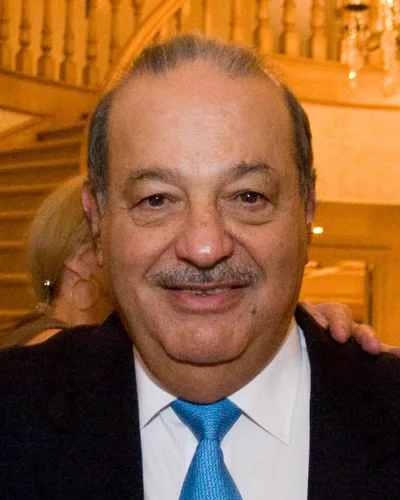
Mexican business oligarch (born 1940)
Carlos Slim Helú is a Mexican business oligarch, investor and philanthropist. From 2010 to 2013, Slim was ranked as the richest person in the world by Forbes business magazine. He derived his fortune from his extensive holdings in a considerable number of Mexican companies through his conglomerate, Grupo Carso. As of July 2025, the Bloomberg Billionaires Index ranked him as the 18th-richest person in the world, with a net worth of US$99.1 billion, making him the richest person in Latin America.
Reading the log…
Slim was born on 28 January 1940, in Mexico City, to Julián Slim Haddad (born Khalil Salim Haddad Aglamaz) and Linda Helú Atta, both Maronite Christians from Lebanon. He decided at a young age that he wanted to be a businessman when he grew up, and received business lessons from his father, who taught him basic financial, business management, and accounting principles by instructing him in how to analyze and interpret financial statements in addition to stressing the young Carlos in the importance of keeping accurate financial records when doing business. At the age of 11, Slim invested in a government savings bond, which taught him about the concept of compound interest. Adhering to his father's emphasis on the importance of keeping accurate financial records, he eventually saved every financial and business transaction he ever made into a personal ledger book, which he still keeps to this day. At the age of 12, he made his first stock investment, by buying shares outright of a Mexican bank. By the age of 15, Slim had become a shareholder in Mexico's largest bank. At the age of 17, he earned 200 pesos a week working for his father's company. He went on to study civil engineering at the National Autonomous University of Mexico, where he also concurrently taught algebra and linear programming. Though Slim was a civil engineering major, he also displayed an interest in economics. Broadening his academic interests outside his traditional area of study beyond civil engineering, he took economics courses in Chile when he completed his engineering degree. Graduating as a civil engineering major, Slim has stated that his mathematical ability and his background of linear programming was a key factor in helping him gain a competitive edge in the business world, especially when analyzing the financial statements of prospective companies while making his business decisions as well as evaluating potential investment acquisitions and stock purchases.
Slim was married to Soumaya Domit from 1967 until her death in 1999. Among her interests were various philanthropic projects. Slim has six children: Carlos, Marco Antonio, Patrick, Soumaya, Vanessa, and Johanna. His three older sons serve in key positions in the companies controlled by Slim where most are involved in the day-to-day running of Slim's business empire. Slim underwent heart surgery in 1999. In high school, Slim's favorite subjects were history, cosmography, and mathematics. Slim and his wife had a very happy marriage, and he indicated that he does not intend to remarry. In his office, Slim does not have a computer, and instead keeps all his financial data in hand-written notebooks. Due to the vast size of his business empire, he often jokes that he cannot keep track of all the companies he manages. Slim is a Maronite Catholic, and he is one of the prominent backers of Legion of Christ, a Roman Catholic religious institute.
Slim's father, Khalil Salim Haddad Aglamaz, was born on 17 July 1888 in Jezzine, Lebanon (then part of the Ottoman Empire). In 1902, at the age of 14, Haddad emigrated to Mexico alone, and later changed his name to Julián Slim Haddad. It was not uncommon for Lebanese children to be sent abroad before they reached the age of 15 to avoid being conscripted into the Ottoman Army, and four of Haddad's older brothers were already living in Mexico at the time of his arrival. In 1911, Julián established a dry goods retail store, La Estrella de Oriente (The Star of the Orient). By 1921, he had begun investing in real estate in the flourishing commercial district of Mexico City where he acquired prime Mexican real estate at fire sale prices in the Zocalo District during the 1910–1917 Mexican Revolution. By 1922, Julián's net worth reached $1,012,258 pesos (equivalent to $197,746,073,681 in 2025), diversified among a vast array of assets that included large swathes of investment-grade real estate, multiple businesses, and stocks. In August 1926, Julián Slim married Linda Helú Atta. Linda, of Lebanese ancestry, was born in Parral, Chihuahua. Her parents had immigrated to Mexico from Lebanon in the late 19th century. Upon immigrating to Mexico, her parents founded one of the first Arabic-language magazines for the Lebanese-Mexican community, using a printing press they had brought with them. Julián and Linda had six children: Nour, Alma, Julián, José, Carlos, and Linda. Julián senior died in 1953, when Carlos was 13 years old. In February 2011, Julian, the oldest brother of Carlos, died aged 74. …
Slim has been publicly skeptical of The Giving Pledge by Bill Gates and Warren Buffett giving away at least half of their fortunes. But—according to his spokesman—he devoted US$4 billion, or roughly 5%, to his Carlos Slim foundation as of 2011 (equivalent to $5,724,852,071 in 2025). Though Slim has not gone as far as Gates and Buffett in pledging more than half of his fortune, Slim has expressed firm support for philanthropy and has advised budding entrepreneurs that businessmen must do more than give—they "should participate in solving problems". In 2019, Forbes put Slim in the list of the world's most generous philanthropists outside of the US.
On 29 March 2007, Slim surpassed American investor Warren Buffett as the world's second-richest person, with an estimated net worth of US$53.1 billion (equivalent to $82,449,446,317 in 2025) compared with Buffett's US$52.4 billion (equivalent to $81,362,542,128 in 2025). On 4 August 2007, The Wall Street Journal ran a cover story profiling Slim. The article said, "While the market value of his stake in publicly traded companies could decline at any time, at the moment he is probably wealthier than Bill Gates". According to The Wall Street Journal, Slim credits part of his ability to "discover investment opportunities" early to the writings of one of his friends, futurist author Alvin Toffler. On 8 August 2007, Fortune magazine reported that Slim had overtaken Gates as the world's richest person. Slim's estimated fortune soared to US$59 billion (equivalent to $91,610,495,908 in 2025), based on the value of his public holdings at the end of July. Gates' net worth was estimated to be at least US$58 billion (equivalent to $90,057,775,638 in 2025). On 5 March 2008, Forbes ranked Slim as the world's second-richest person, behind Warren Buffett and ahead of Bill Gates. On 11 March 2009, Forbes ranked Slim as the world's third-richest person, behind Gates and Buffett and ahead of Larry Ellison. On 10 March 2010, Forbes once again reported that Slim had overtaken Gates as the world's richest person, with a net worth of US$53.5 billion (equivalent to $78,988,631,161 in 2025). At the time, Gates and Buffett had a net worth of US$53 billion (equivalent to $78,250,419,655 in 2025) and US$47 billion (equivalent to $69,391,881,581 in 2025) respectively. He was the first Mexican to top the list. It was the first time in 16 years that the person on top of the list was not from the United States. It was also the first time the person at the top of the list was from an emerging economy. …
Biographical detail compiled from Wikipedia and Wikidata, which are edited openly and may be incomplete or out of date. Fleet data is our own. Source →