 celebyachts.com
The maritime broadsheet of public waters · Register current through 27 Jul 2026
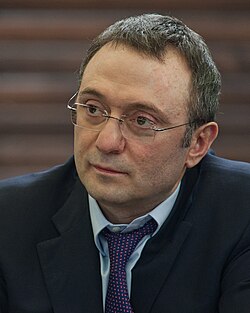
Russian businessman and oligarch
Suleyman Abusaidovich Kerimov is a Russian billionaire, oligarch, philanthropist and politician of Lezgin descent. Kerimov maintains close ties to Vladimir Putin's administration in Russia, and formerly enjoyed a close relationship with Ramzan Kadyrov, the strongman of Chechnya. More recently, Kerimov and Kadyrov have fallen out.
Kerimov was born on 12 March 1966 in Derbent, Dagestan, into a Dagestani Lezgin family, he belongs to the Lezgin sikhil (clan) Tvarkar. His ancestral village is said to be Karakyure in the Dokuzparinsky District. He graduated from high school in 1983 and subsequently enrolled in the Civil Engineering Department at the Dagestan Polytechnic Institute in 1984, although his obligatory military service in the Soviet Army interrupted his studies barely a year later. After completing his service in 1986, Kerimov resumed his studies at Dagestan State University, from which he graduated with a degree in financial accounting and economics in 1989. While a student, he served as deputy chairman of the university's Trade Union Committee. It was also at university that Kerimov met his wife, Firuza, the daughter of a former trade union leader. Kerimov has said that he had dreamed of making money from an early age, an ambition that later prompted him to leave his native Dagestan in the early 1990s.
In 2003, Kerimov managed to secure a $43 million loan from the state-owned Vnesheconombank, which he invested in the oil and gas company Gazprom. Within the next year, share prices for the Russian gas company doubled and Kerimov was able to pay off the entirety of the loan within four months. In 2004 Sberbank, now the largest bank in Russia and Eastern Europe, provided Kerimov with a loan of $3.2 billion, which was later repaid, and these funds were also invested in equities. By 2008, Kerimov had amassed a 5% stake in Gazprom, a 6% stake in Sberbank, along with an estimated fortune of $17.5 billion, making him the 36th richest man in the world. However, in mid-2008, Kerimov sold all his Gazprom and Sberbank shares.
In 2006 Kerimov was listed among the world's 100 richest people and as Russia's eighth richest man ranked by Forbes. He had a net worth of $6.9 billion as of 2014, with the previous years' net worth estimated at $7.1 billion (2013) and $6.5 billion (2012). In 2020, Kerimov's fortune doubled due to a sharp rise in gold prices. In August 2020, he became the richest businessman in Russia for a while. His family's fortune, almost entirely based on the 77 percent holding in gold company Polyus, was estimated at $24.7 billion. At the end of 2020, the value of the assets of the Kerimov family was estimated at $20.9 billion. By 2022, his wealth had decreased to $11 billion. He keeps vast assets through networks of offshore companies. He owns a villa in Cap d'Antibes, France (Villa Hier). On 26 November 2006, in Nice, France, Kerimov was seriously injured after losing control of a $650,000 Ferrari Enzo on the Promenade des Anglais. He suffered severe burns as a result of the accident. Known for spending much of his fortune on parties, the Russian billionaire has paid for celebrities such as Christina Aguilera, Shakira, Amy Winehouse and Jessie J to perform at his events. From 2005 to 2015, Kerimov owned one of the world's largest private yachts, which is known as Ice. Previously known as Air, she was built by German company Lürssen in 2005. Ice measures 295 feet (90 metres) in length, and can reach a speed of 18.6 knots (34.4 km/h; 21.4 mph). She has won the Superyacht of the Year award at the World Superyacht Awards in 2006, and is currently the 78th largest yacht in the world. He sold Ice to The Ministry of Defence for the Republic of Equatorial Guinea in 2015. In 2022 there were reports that he was the owner of the superyacht Amadea. In April 2022, it was seized by Fiji police at Lautoka Port as Fijian high court granted a restraining order to Fiji Police to restrain it for being allegedly linked with Kerimov. In May 2022, Fiji's High Court ruled that US authorities can seize the yacht. A possible Fabergé egg was found aboard the yacht. In February 2024, US authorities revealed their desire to auction the yacht due to its "excessive" upkeep. The yacht reportedly costs $7 million a year to maintain and monthly costs include $360,000 to pay
Soon after his university graduation in 1989, Kerimov took a job as an economist at the Eltav electrical plant in Makhachkala, the capital of Dagestan. The state-controlled plant supplied transistors and semi-conductors to television-makers, while also producing diodes, microchips and halogen lamps. Kerimov was paid 150 roubles (approximately $250 dollars) a month and he and his wife lived in a worker's hostel attached to the plant, where they shared one room of a two-room flat. Eventually, Kerimov rose to the rank of Deputy Director General at Eltav and began to dabble in investing during the fall of the Soviet Union.
Forbes magazine describes Kerimov as one of the most private Russian billionaires, who has not given a single interview over 20 years in business. Moscow Times quoted a former deputy editor of Forbes Russia Kirill Vishnepolsky as describing Kerimov as a "Russian Warren Buffett" for a similarly astute investment style. A senior Moscow banker is reported to have said of Kerimov: "Sometimes it is difficult to talk to him. He is always a few steps ahead of you. For foreigners, it is next to impossible, even those used to a Russian environment. He is very quick and creative, in a sense that ideas come to him that don't come to other people". Kerimov reportedly made extensive use of leverage for his investments, according to financiers and bankers active in Russia.
Shortly after Kerimov bought into Nafta Moskva, the company found itself in a conflict with businessman Andrei Andreev. Andreev's assets were transferred to Nafta Moskva, Millhouse Capital and Basic Element. Further dispute brought the parties to the court. In July 2004 Andreev and Nafta Moskva reached an amicable settlement and the dispute was resolved.
From 1999 to 2003, Kerimov was a member of the State Duma of the 3rd Convocation, the lower house of the Federal Assembly of Russia, as well as a member of the State Duma Committee for Security. From 2003 to 2007, while continuing his role on the Committee for Security, he was also a member of the 4th Convocation and Deputy Chairman of the State Duma Committee for Physical Education, Sports and Youth. He first gained a seat in parliament with the Liberal Democratic Party, led by Vladimir Zhirinovsky. Since 2008, Kerimov has served as a member of the Federation Council of the Federation Assembly of the Russian Federation – the upper house of the Federation Assembly— and represents the Republic of Dagestan. In response to the Russian parliament's passage of a bill prohibiting government officials from holding foreign-issued securities and bank accounts abroad, Kerimov transferred his assets to the trusts controlled by Suleyman Kerimov Foundation, a charity registered in Switzerland, in May 2013. This way, he retained both his position in the Federation Council and beneficiary rights to his business assets. Later, Kerimov's son Said became the sole beneficiary of the said trusts. Suleiman Kerimov was re-elected to the Federati
In April 2018, the United States imposed sanctions on Kerimov and 23 other Russian nationals. Kerimov is one of many Russian oligarchs named in the Countering America's Adversaries Through Sanctions Act, CAATSA, signed into law by President Donald Trump in 2017. Also sanctioned by the UK government on 15 March 2022 in relation to the Russo-Ukrainian War.
Kerimov's father was a lawyer at a criminal investigation institution, while his mother was an accountant for the Savings Bank of Russia. He is married and has three children. In October 2011, Kerimov used his connections to fly Western financial figures such as Jamie Dimon of JPMorgan, Richard Parsons of Citigroup and Stephen Schwarzman of Blackstone to Moscow in support of Medvedev's initiative to turn Moscow into an "international financial centre".
Biographical detail compiled from Wikipedia and Wikidata, which are edited openly and may be incomplete or out of date. Fleet data is our own. Source →