 celebyachts.com
The maritime broadsheet of public waters · Register current through 27 Jul 2026
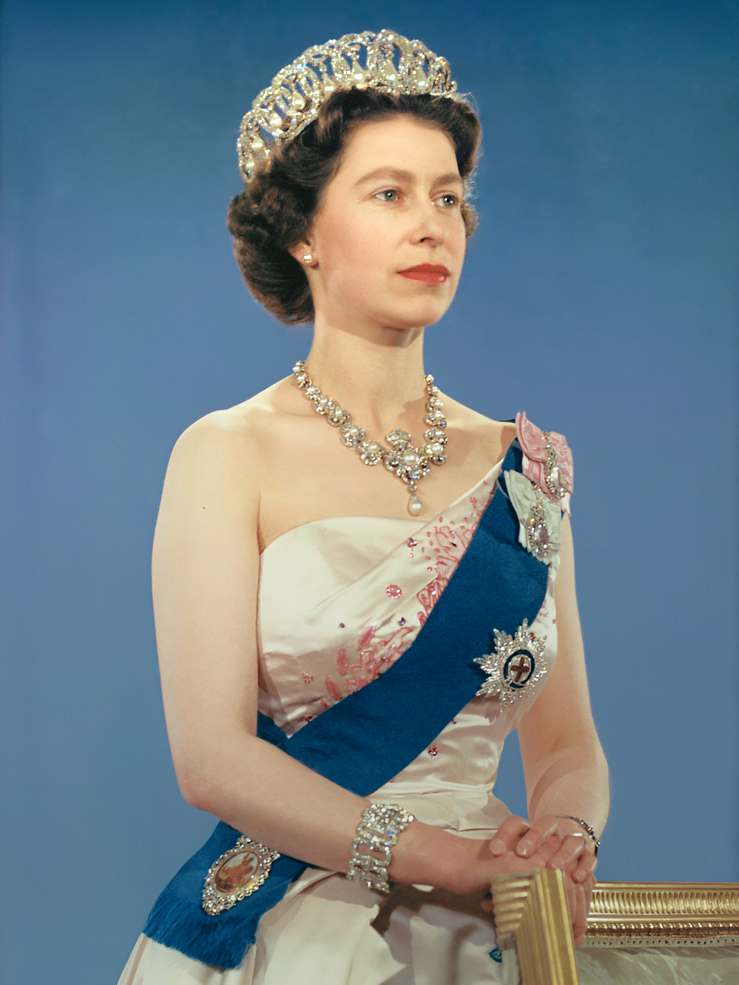
Queen of the United Kingdom from 1952 to 2022
Elizabeth II was Queen of the United Kingdom and other Commonwealth realms from 6 February 1952 until her death in 2022. She was queen regnant of 32 sovereign states during her lifetime and was the monarch of 15 realms at her death. Her reign of 70 years and 214 days is the longest of any British monarch, the second-longest of any sovereign state, and the longest of any queen regnant in history.
Elizabeth was born at 2:40 am on 21 April 1926 by Caesarean section at her maternal grandfather's London home, 17 Bruton Street in Mayfair, the first child of Prince Albert, Duke of York (later King George VI), and his wife, Elizabeth, Duchess of York (later Queen Elizabeth the Queen Mother). Her father was the second son of King George V and Queen Mary, and her mother was the youngest daughter of Scottish aristocrat Claude Bowes-Lyon, 14th Earl of Strathmore and Kinghorne, and his wife Cecilia (née Cavendish-Bentinck). She was baptised in the private chapel at Buckingham Palace on 29 May by the Archbishop of York, Cosmo Gordon Lang, and was named Elizabeth after her mother; Alexandra after her paternal great-grandmother, who had died five months earlier; and Mary after her paternal grandmother. Her close family affectionately called her "Lilibet", based on what she called herself at first. She was cherished by her grandfather George V, whom she affectionately called "Grandpa England", and her regular visits during his serious illness in 1929 were credited in the popular press and by later biographers with raising his spirits and aiding his recovery.
Elizabeth's sole sibling, Princess Margaret, was born in 1930. They were cared for by their nanny, Clara Knight, and educated at home under the supervision of their mother and their governess, Marion Crawford. Lessons concentrated on history, language, literature, and music. Crawford published a biography of Elizabeth and Margaret's childhood years titled The Little Princesses in 1950, much to the dismay of the royal family. The book describes Elizabeth's love of horses and dogs, her orderliness, and her attitude of responsibility. Others echoed such observations: Winston Churchill described Elizabeth when she was two as "a character. She has an air of authority and reflectiveness astonishing in an infant." Her cousin Margaret Rhodes described her as "a jolly little girl, but fundamentally sensible and well-behaved". Elizabeth's early life was spent primarily at the Yorks' residences at 145 Piccadilly (their town house in London) and Royal Lodge in Windsor.
Elizabeth met her future husband, Prince Philip of Greece and Denmark, in 1934 and again in 1937. They were second cousins once removed through King Christian IX of Denmark and third cousins through Queen Victoria. After meeting for the third time at the Royal Naval College in Dartmouth in July 1939, Elizabeth – though only 13 years old – said she fell in love with Philip, who was 18, and they began to exchange letters. She was 21 when their engagement was officially announced on 9 July 1947. The engagement attracted some controversy. Philip had no financial standing, was foreign-born (though a British subject who had served in the Royal Navy throughout the Second World War), and his sisters had married German noblemen with Nazi links. Marion Crawford wrote, "Some of the King's advisors did not think him good enough for her. He was a prince without a home or kingdom. Some of the papers played long and loud tunes on the string of Philip's foreign origin." Later biographies reported that Elizabeth's mother had reservations about the union initially and teased Philip as "the Hun". In later life, however, she told the biographer Tim Heald that Philip was "an English gentleman".
Before the marriage, Philip renounced his Greek and Danish titles, officially converted from Greek Orthodoxy to Anglicanism, and adopted the style Lieutenant Philip Mountbatten, taking the surname of his mother's British family. Shortly before the wedding, he was created Duke of Edinburgh and granted the style His Royal Highness. Elizabeth and Philip were married on 20 November 1947 at Westminster Abbey. They received 2,500 wedding gifts from around the world. Elizabeth required ration coupons to buy the material for her gown (which was designed by Norman Hartnell) because Britain had not yet completely recovered from the devastation of the war. In post-war Britain, it was not acceptable for Philip's German relations, including his three surviving sisters, to be invited to the wedding. Neither was an invitation extended to the Duke of Windsor, formerly King Edward VIII. Elizabeth gave birth to her first child, Prince Charles, in November 1948. One month earlier, the King had issued letters patent allowing her children to use the style and title of a royal prince or princess, to which they otherwise would not have been entitled, as their father was no longer a royal prince. A second child, Princess Anne, was born in August 1950. Following their wedding, the couple leased Windlesham Moor, near Windsor Castle, until July 1949, when they took up residence at Clarence House in London. At various times between 1949 and 1951, Philip was stationed in the British Crown Colony of Malta as a serving Royal Navy officer. He and Elizabeth lived intermittently in Malta for several months at a time in the hamlet of Gwardamanġa, at Villa Guardamangia, the rented home of Philip's uncle Lord Mountbatten. Their two children remained in Britain.
On 8 September 2022, Buckingham Palace stated, "Fo
Biographical detail compiled from Wikipedia and Wikidata, which are edited openly and may be incomplete or out of date. Fleet data is our own. Source →